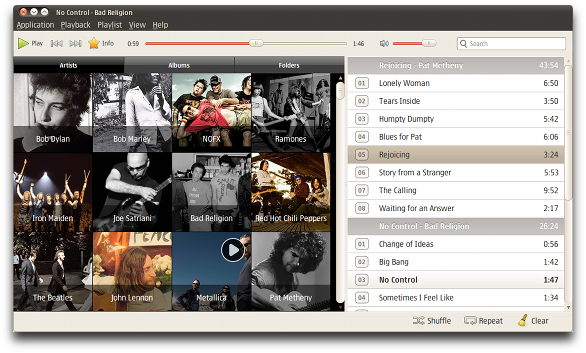
 Minitunes is pretty close to its first release. Now’s the time to test it and give feedback about bugs and crashes. Linux users can get the 32bit binaries or build by themselves from source code. Mac users can download this dmg (Intel, Leopard or Snow Leopard required). I especially need testing on Leopard. Please report your experience in the comments and don’t forget to specify your operating system version. Thanks in advance.
Author Archive
Let’s test Minitunes
Minitube in Debian unstable
Minitube has been uploaded to Debian Sid, the unstable version of Debian. Hopefully the package will continue its trip to testing and finally to a stable release. The inclusion in Debian unstable also means that most Debian derivatives will inherit the package. Interestingly, the package directly depends on the GStreamer backend and required codecs.
This is a great achievement for me. Having a single line of code in Debian has always been a dream for me, let alone an entire package. Thanks to anyone who helped getting Minitube in Debian!
By the way, I thought I would be quite happy about this and think I am, but I really can’t feel it since I lost my job a few days ago and I’m still in the process of reorganizing and deciding what to do with my life. It’s hard to feel the love in this kind of situation. But I’ll get over it.
Mac screenshots
Minitunes is shaping up nicely and works great on the Mac.
 And here’s what I call the Info View:
 Will Mac users escape the reality distortion field?
Playlist bliss

And here’s the code.
Minitube reaches version 1.0
Minitube 1.0 is finally here. It fixes some content from major labels failing to play and adds the ability to play Full HD (1080p) videos when available. This version also adds the ability copy the video stream URL, so you can download the video with an external program.
A whole slew of new translations are available: Romanian, Greek, Dutch, Arabic, Portuguese, Finnish and Bulgarian. Thanks to the translators and to all the people that keep suggesting enhancements and spreading the word out.
After downloading and setting up Minitube 1.0, you may want to make a donation so I can have free beer tomorrow evening in Rome.
Minitunes source code on Gitorious
This is a first step towards the release of Minitunes, the music player that will change your living room for good. If you have one, that is. Anyway, code quality is at a historic low, features are at best incomplete or completely broken. It may not compile, it may even move the window buttons on the left, no wait that’s another story.
Enough with disclaimers. The code is hosted at Gitorious. If you’re interested in building it, get it with Git and follow the INSTALL instructions. If you like what you see and feel you’re in the right place at the right time, then please consider joining the project. It’s gonna be fun.
Call for Minitube 1.0 translations
Minitube 1.0 is done and waiting for cool people around the world to translate it. If you want to become one of them just send me an email. I’ll send you a simple file you can translate and send back to me.
Here’s the current translation status.
   ar.ts :  100%    0/(89-0)
cs_CZ.ts :  100%    0/(107-18)
de_DE.ts :  100%    0/(118-29)
el_GR.ts :  100%    0/(117-28)
es_AR.ts :   60%    36/(106-17)
es_ES.ts :   81%    17/(112-23)
   es.ts :  100%    0/(112-23)
fi_FI.ts :  100%    0/(89-0)
fr_FR.ts :  100%    0/(102-13)
   gl.ts :  100%    0/(117-28)
he_IL.ts :  100%    0/(106-0)
hr_HR.ts :   83%    16/(102-13)
hu_HU.ts :  100%    0/(102-13)
it_IT.ts :  100%    0/(106-17)
ja_JP.ts :   77%    21/(98-9)
  lat.ts :  100%    0/(103-0)
nb_NO.ts :   97%    3/(102-13)
nl_NL.ts :  100%    0/(89-0)
pl_PL.ts :  100%    0/(107-18)
pt_BR.ts :  100%    0/(117-28)
pt_PT.ts :  100%    0/(89-0)
ro_RO2.ts :   76%    22/(102-13)
ro_RO.ts :  100%    0/(102-13)
ru_RU.ts :  100%    0/(117-28)
tr_TR.ts :  100%    0/(118-29)
   uk.ts :  100%    0/(117-28)
If your mother tongue is not included in the list above, please consider becoming a Minitube translator.
Carne di porco, ovvero incontro con RaiNet
Ieri ho partecipato a un incontro dal titolo Convergiamo organizzato da RaiNet. Sorvolo sugli inutili dibattiti sulla crossmedialità e altre snobistiche fantasticherie.
Il responsabile tecnico RaiNet ha introdotto di sua iniziativa il problema Silverlight e “hacker”. Vi posso assicurare dal tono e dalle espressioni usate che è un tema “caldo”. Il reponsabile tecnico ha ammesso che le misure di protezione sono continuamente “bucate” da un gruppo di “hacker che fanno carne di porco dei contenuti RAI”. Proprio così. A quel punto ho alzato la mano e ho detto: “Buonasera, sono uno di quelli che fanno carne di porco…” e la sala si è fatta una bella risata! C’è anche una testimonianza con qualche commento. Mi sono brevemente opposto alla connotazione negativa che sembrava insinuare chissà quali loschi fini dicendo che noi “craccatori” siamo solo utenti normali e quelli che vogliono vedere le dirette sul VLC sono una fetta di comunissimi utenti. Ho riassunto rapidissimamente le ragioni per cui c’è un interesse diffuso a vedere le dirette fuori da rai.tv:
- Silverlight non si può installare su computer un po’ vecchi. Ad es. AMD Athlon
- Consuma più CPU, quindi scarica molto più in fretta la batteria di un portatile
- La qualità video è inferiore
- Le dirette non sono fruibili su device come smartphone e mediacenter.
- Problemi diffusi di installazione e funzionamento si Silverlight
- Non ho fatto in tempo a dire: Moonlight funziona solo su Firefox e non su altri browser, ma non so quanto sarebbe stato capito: per i mediaroli presenti in sala usare il Mac è ancora di moda.
RaiNet giustifica i continui tentativi di rendere inaccessibili le dirette al di fuori di rai.tv sostenendo che “non hanno i diritti”. Cioè che i diritti che acquisiscono per alcuni dei contenuti trasmessi sono limitati al sito rai.tv. Un esempio sono state le ultime Olimpiadi invernali per le quali hanno corso, a quanto hanno detto, il rischio di dover sospendere gli stream. Inoltre sostengono di non essere nella posizione di ottenere questo diritto.
Avrei voluto proporre una nuova strategia oltre alle critiche, ma questa notizia sui problemi di diritti e la tendenza a non farmi più intervenire mi ha bloccato. La strategia è semplice.
- Rinunciare a pubblicità aggiuntiva rispetto a quella già presente in tv.
- Aprire l’accesso alle dirette e ai contenuti on-demand creando un API documentata e pubblica in modo da rendere possibile a terze parti sviluppare software integrando i contenuti RAI su qualunque sistema operativo e device.
- Fare reportistica non in base alle pageview e accessi unici del sito. Ma in base agli accessi agli stream.
- In questo modo possono aggiungere valore alla pubblicità che già raccolgono e migrare veramente la RAI su internet perché l’epoca della TV sta finendo.
Ma insomma, questo presuppone che abbiano i diritti per farlo.
In chiusura ho potuto parlare a tu per tu con il responsabile tecnico. Mi ha anticipato che in vista delle prossime Paralimpiadi, per evitare rischi, useranno il DRM di Windows Media. Questo significa che Linux (e tutto ciò che non è Windows e Mac) sarà escluso dalle dirette. Gli ho anticipato che questo cambiamento non sarà accolto benissimo…
Ho fatto in tempo anche a raccontargli la storia di Matthew che mi ha colpito e spero abbia colpito anche lui. Alla fine, leggermente disgustato da alcuni sproloqui di mediaroli di mezz’età, ho preso il vespone e sono tornato a casa.
Minitube is in Ubuntu repositories
Thanks to the efforts of Christian Mangold, Minitube has been packaged and uploaded into Ubuntu’s universe repository for the upcoming Lucid Lynx release. This means that starting from April 2010 Ubuntu users will be able to install it in a few clicks using the Ubuntu Software Center application.
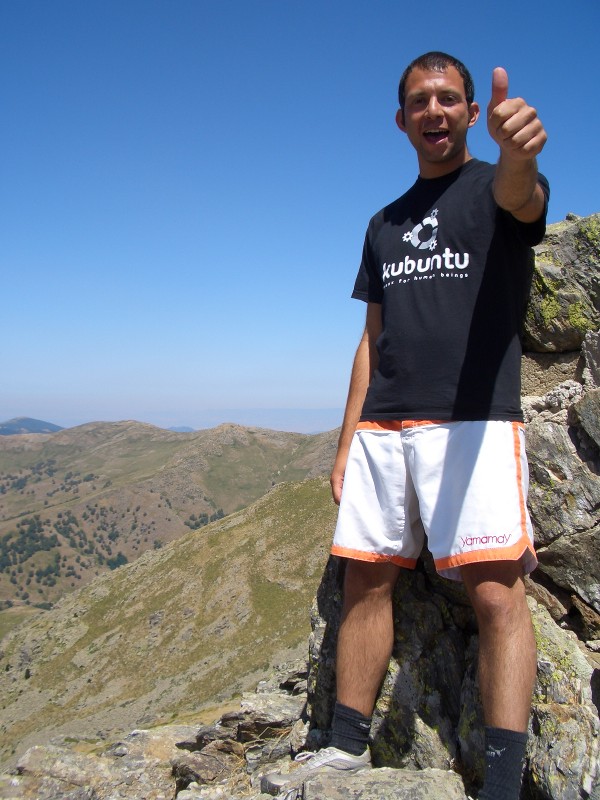
This is such a great news! I tried but I really cannot convey what I feel in English words, so I’ll try with an image. Here’s a cheesy picture of me in 2007 after reaching Sardinia’s highest peak, proudly wearing a self-made Kubuntu shirt! ;)